#NTN #UAV #MIMO
H.-J. Moon, C.-B. Chae
Published in IEEE Journal on Selected Areas in Communications, Jan. 2025
Abstract
In this paper, we investigate a multi-user downlink scheduling and power allocation strategy for urban air mobility (UAM) within a 6G non-terrestrial network (NTN) framework that integrates satellite and ground networks. We consider a system model involving multiple ground stations (GSs) and a single satellite, addressing the sum rate maximization problem with link-association, power, elevation angle, and minimum quality-of-service constraints. The proposed method initially segregates satellite-serviced users to reduce interference among the remaining GS-serviced users, taking into account the locations and movements of those UAMs. Subsequently, using a graph-theoretical approach, we convert the GS link association problem into a minimum-cost maximum-flow problem. In this process, we employ an analytical method involving polynomial approximations or a numerical method using integral approximation through the sum of time-sampled parameters. We then address the non-convex power allocation problem for scheduled links through iterative algorithms. The proposed scheduling and power allocation algorithms effectively manage interference in multi-UAM and multi-GS environments, and their performance is validated through extensive simulation results. Our study provides a comprehensive framework and strategy for efficient downlink transmission in future UAM operations, paving the way for novel applications in 6G NTN.
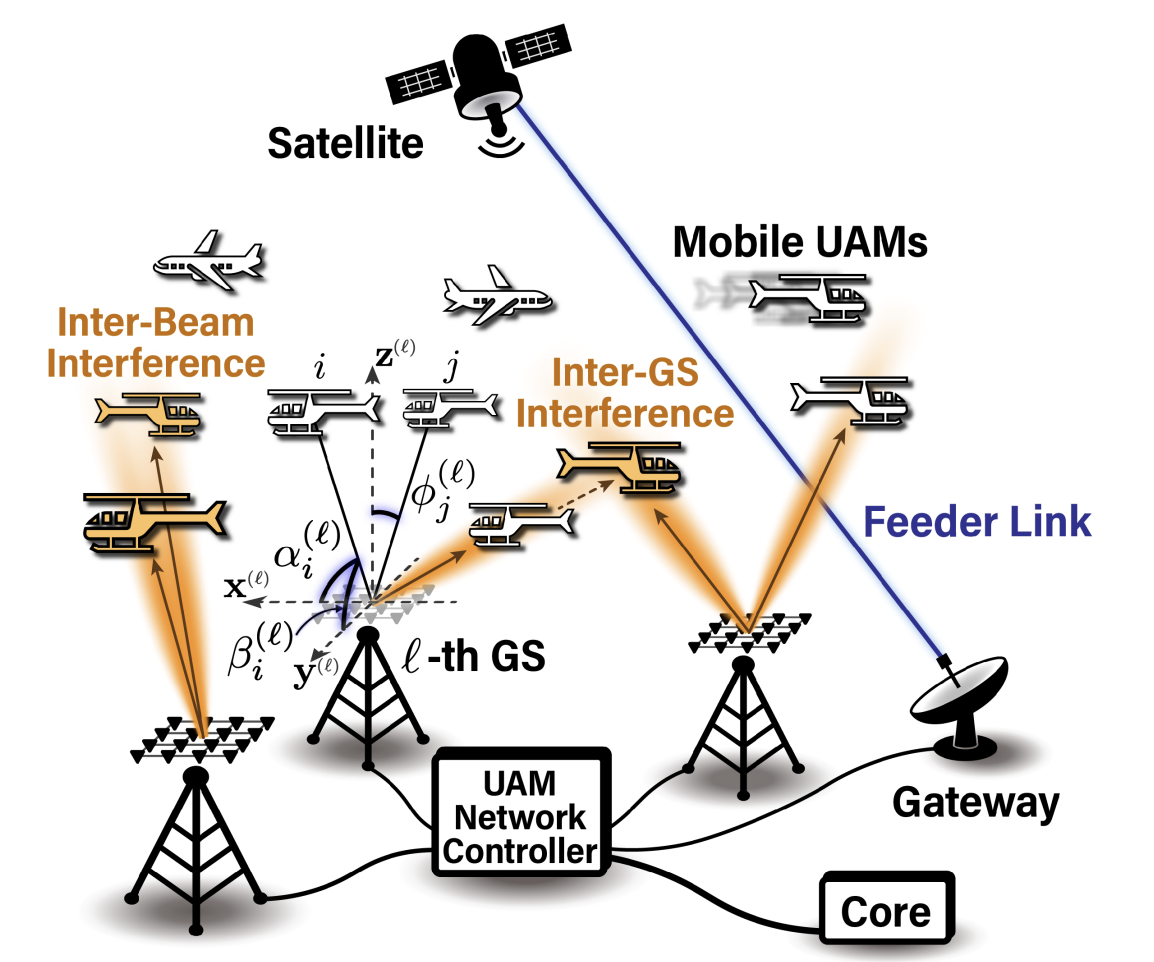
System model.
© 2021, Ritij Jain | Pudhina Fresh theme for Jekyll.